
More than walls: 47 years of high-end production
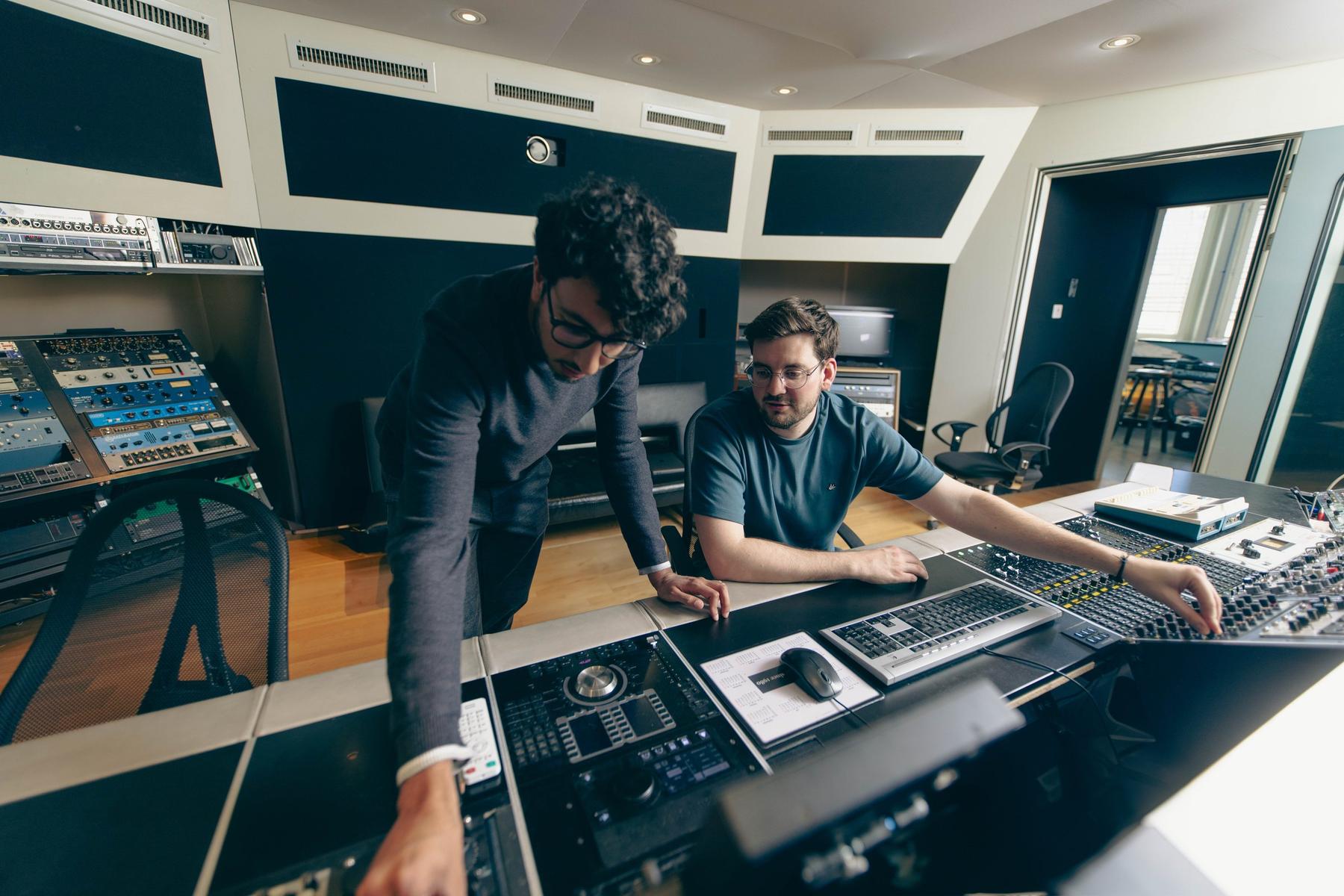
In the heart of Lucerne: The Dolby Atmos control room at Soundville Media Studios forms the technical foundation for ORISONO's international film projects.
Behind Soundville Media Studios is René Zingg, an experienced sound engineer who has built the establishment over decades into one of the premier addresses for high-end audio and film production. Spanning approximately 700 square meters, the studios house multiple recording rooms, dedicated Foley areas, and one of Switzerland's few Dolby Atmos-certified mixing studios. This concentration of specialized technology is typically found only in major production centers. Accordingly, projects for clients such as Netflix, Warner Bros, and the Sphere in Las Vegas have found their home here over the years, where established craftsmanship and cutting-edge technology are seamlessly intertwined.
The Sound of the Future: Dolby Atmos Live in Lucerne
The true heart of the facility is Control Room A, the main control room of the studios. At over 60 square meters, of which about 30 square meters remain accessible after the installation of acoustic insulation, it is anything but an ordinary control room. It was designed by Tom Hidley, one of the most influential studio designers in history, who invented flush-mounted wall monitors and the bass trap, and completed over 300 studios worldwide. Together with René Zingg and the Swiss architect Thomas Rast, Hidley realized Control Room A according to his principle of the Non-Environment Room: The room is acoustically neutralized to such an extent that one only hears the loudspeakers and the recording, not the room itself. This is crucial for mixing, because a mix that convinces here will reliably sound good in the cinema, on television, and through headphones. This is the basis for the Dolby Atmos certification, an object-based format that allows individual sounds to be freely placed in space and even at different heights, instead of just assigning them to fixed channels.
Cinema feeling in the studio: When picture and sound play perfectly
The studio also offers reference conditions for the visual side. Post-production Editing Suite 1 is designed like a small cinema, with a professional projector, a large screen, and a calibrated Dolby Atmos system. Directors and editors see and hear their films as the audience will later experience them in the cinema, allowing them to perfectly align picture and sound. This combination of high-resolution projection and reference-grade sound makes the studios a prime destination for post-production clients.
It is precisely in this environment that ORISONO has established itself. The production company utilizes the infrastructure to realize its own projects, and the proximity to technology is not merely a convenience but a fundamental working principle. From the initial brainstorming in the office to the final Dolby Atmos mix in the adjacent room, the distances are short. The value of this direct connection between creation and technology is evident in films like Sew Torn, which screened at the Locarno Film Festival, among others. Ideas and their technical implementation thus emerge in the same place, eliminating friction caused by lengthy transport routes.
A Pledge to Quality: Lucerne as a Tech Hub
This bundling of expertise benefits the entire Lucerne film industry. Located in the heart of the city, easily accessible yet shielded from street noise, Grimselweg 5 covers the entire production chain under one roof. Filmmakers no longer need to travel abroad for high-end post-production. From large film sets to isolated vocal booths and certified Atmos mixing suites, everything is available in one place.
This makes Soundville Media Studios more than just a production location. They prove that Lucerne is not only a picturesque backdrop but a technically competitive hub. In an industry where content is produced ever faster, time is deliberately preserved here for meticulous work. This is how sound for productions that find their way onto international screens is created right in the heart of Lucerne.